Skip to content
Available for select projects

From complex requirements to production-ready software.

I'm Tareq Hasan, a Full Stack Engineer who helps founders and product teams turn ideas into reliable software. I build SaaS platforms, POS and inventory management systems, backend APIs, automation workflows, and AI-integrated applications — taking ownership from system architecture and database design to implementation and production deployment.

Production stack · built end to end

ReactNext.jsReact NativeNode.jsNestJSPythonPostgreSQLMongoDBRedisDocker
tareq@production
$pnpm build
okcompiled successfully
$docker compose up -d
okapi listening :4000
okpostgres healthy
okredis healthy
~deploying to production...
>

Focus

SaaS & backend systems

Based in

Dhaka, Bangladesh · Remote

01Services

Engineering support for the parts of your product that matter most.

Focused engagements for teams that need a dependable full-stack engineer — whether you are starting something new or fixing what is already in production.

01

Full-Stack Web Application Development

You have a product idea or an outdated application and need it built end-to-end by one engineer who owns the frontend, backend and database.

  • Responsive React / Next.js interfaces
  • Backend services and data models
  • Authentication and user roles
  • Ongoing improvements and bug fixes

Value: A single accountable engineer taking your product from requirements through to a working, deployed application.

02

SaaS & Multi-Tenant Platforms

You are building a subscription product where multiple organisations, plans, permissions and billing have to coexist safely.

  • Tenant isolation and role-based access control
  • Plan-based limits and feature gating
  • Subscription billing workflows
  • Admin and customer dashboards

Value: A foundation that supports real customers and paid plans instead of a demo that breaks at the first tenant.

03

Backend & REST API Engineering

Your frontend or partner systems need reliable, secure and well-structured APIs they can depend on.

  • REST APIs with validation and error handling
  • JWT / session authentication
  • Third-party and internal integrations
  • Documented, versionable endpoints

Value: Backends that are predictable for the teams and clients consuming them, and maintainable for the long term.

04

Database Design & Performance

Slow queries, unclear schemas or growing data make your application brittle as usage increases.

  • Relational and document schema design
  • Query optimisation and indexing
  • Caching with Redis where it helps
  • Migrations and safe data changes

Value: Faster, more predictable applications and schemas you can keep building on as your product grows.

05

Payments, Integrations & Real-Time

Your product depends on payments, media, or live updates and those integrations have to be reliable.

  • Stripe payments and subscription flows
  • File, media and image integrations
  • WebSockets and event-driven features
  • Background and scheduled processing

Value: The connective features that turn a static application into a product customers can actually transact and interact with.

06

Deployment, Docker & Production Readiness

Moving from a local build to something stable, secure and observable in production is often the hardest step.

  • Dockerised applications and environments
  • CI/CD and repeatable deploys
  • Linux / VPS and cloud deployment
  • Environment and secrets management

Value: A deployable, maintainable system your team can run and update confidently.

Also available for existing application improvements and bug fixes on a short-term basis.

02Selected work

Case studies from requirements to production.

Each project below is a real system I architected and built — chosen for the engineering depth involved. Where numbers aren't available, the scope and decisions speak for themselves.

pos-sales-live
p95 latency · last 12hanomaly
Spike on /v1/ordershigh
Throughput drift detectedmedium
Multi-Tenant SaaS
Case Study 01

Smart POS & Inventory SaaS

Product design, full-stack engineering and DevOps — from requirements to production

Problem

Retail businesses live on the checkout counter, the stock room and a live picture of what is moving where. Single-shop POS tools fall apart the moment a brand opens a second branch: sales, staff and inventory need to stay isolated per branch while management watches the whole business in real time — and every checkout has to cope with barcode scanners, concurrent sales and stock updates arriving from many locations at once.

Engineering approach
  • Design a multi-tenant, multi-branch data model so each organisation owns its branches, users and inventory behind strict tenant isolation.
  • Own the stack end-to-end — NestJS with Prisma and PostgreSQL on the backend, React with Redux Toolkit on the frontend.
  • Integrate hardware barcode scanners into the checkout flow so line items are added with a single scan and the sale keeps moving.
  • Stream stock and sales changes over WebSockets so every branch sees live quantities against shared inventory.
  • Move heavy work — sales aggregation, stock recalculation and report generation — onto BullMQ and Redis workers instead of blocking the API, cutting processing latency by roughly 40%.
  • Add attribute-based access control so staff permissions are scoped per branch and per capability.
  • Ship it like production: Docker orchestration, GitHub Actions CI/CD, an Nginx reverse proxy and automated database backups.
Solution

A scalable POS SaaS that runs multiple branches from one platform — barcode-driven checkout, real-time inventory sync and business reporting, with tenant isolation, queue-based background processing and a fully automated delivery pipeline.

Outcome
  • Multi-branch sales, stock and operations in one system
  • Real-time inventory sync across branches via WebSockets
  • ~40% lower processing latency with BullMQ + Redis
  • ABAC permissions scoped per branch and role
  • CI/CD, containerised deploys and automated backups
Stack
NestJSNode.jsTypeScriptPrismaPostgreSQLReactRedux ToolkitWebSocketsBullMQRedisABACDockerNginxGitHub Actions
streaming-pipeline
stream live
1

RTMP ingest

OBS publisher

2

FFmpeg transcode

HLS segmentation

3

CDN delivery

edge caching

4

Live viewers

WebSocket status

Real-Time Media Source
Case Study 02

Live Streaming Platform

Backend architecture, streaming pipeline and platform engineering

Problem

Publishing live video to many viewers at once normally means stitching together ingest, transcoding, delivery and access control. The goal was a single, modular system that handles that entire pipeline rather than a fragile one-off setup.

Engineering approach
  • Model a modular NestJS backend so streaming, auth and storage concerns stay decoupled.
  • Accept live stream ingest over RTMP so creators can broadcast from tools like OBS.
  • Transcode and segment the feed with FFmpeg into HLS for smooth playback across networks.
  • Secure streams with role-based access control and persist metadata in PostgreSQL.
  • Push live status to clients over WebSockets and serve delivery through Cloudflare.
Solution

A NestJS service that ingests RTMP, transcodes to HLS with FFmpeg and delivers streams over a CDN, with authentication and role-based permissions guarding who can publish and watch.

Outcome
  • Multi-user support with per-user streams
  • Adaptive HLS playback instead of raw streams
  • Role-based access control across the platform
  • Modular backend designed for extension
Stack
NestJSTypeScriptPostgreSQLFFmpegRTMPHLSWebSocketsCloudflareDocker
api-monitor
p95 latency · last 12hanomaly
Spike on /v1/ordershigh
Throughput drift detectedmedium
Developer Tooling Source
Case Study 03

Intelligent API Monitor

Full-stack engineering across the monitoring backend and dashboard

Problem

Generic uptime checks tell you an endpoint is down, but teams also need to understand degrading behaviour and get alerts that are actually worth reading. The project focused on turning raw API signals into meaningful, prioritised alerts.

Engineering approach
  • Build a monitoring backend that collects API metrics and request behaviour over time.
  • Detect anomalies from the collected data instead of relying on a single static threshold.
  • Integrate an LLM step to turn detected anomalies into readable, contextual alerts.
  • Expose the results through an API for the dashboard to consume.
  • Build a real-time React dashboard with Redux Toolkit for state and live updates.
Solution

A Node.js/Express monitoring service with anomaly detection and AI-generated alert summaries, surfaced through a Vite + React dashboard that visualises anomalies as they happen.

Outcome
  • Anomaly detection on API behaviour rather than binary uptime
  • AI-assisted, human-readable alerting
  • Real-time dashboard for monitoring at a glance
  • Separated backend and frontend for independent scaling
Stack
Node.jsExpressTypeScriptLLM IntegrationReactViteRedux Toolkit
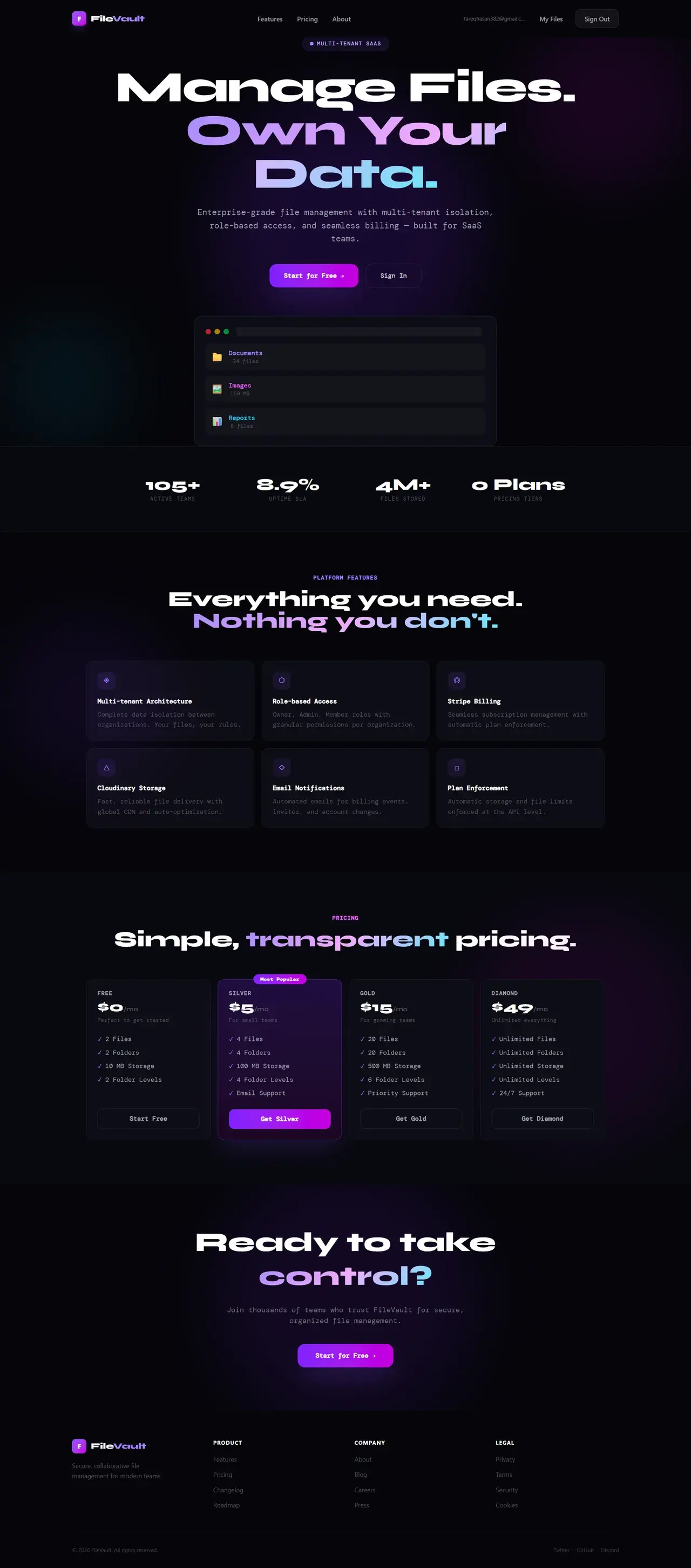
FileVault multi-tenant SaaS file manager interface
Multi-Tenant SaaS Source Live
Case Study 04

FileVault

Full-stack engineering of the API, data model and application

Problem

Teams need shared, secure file storage where each organisation's data is isolated, permissions are enforced and access scales with paid plans — all without leaking one tenant's files to another.

Engineering approach
  • Design a multi-tenant data model with clear ownership boundaries per organisation.
  • Implement role-based access control across SUPER_ADMIN, OWNER, ADMIN and MEMBER roles.
  • Add Stripe subscription billing with plan-based storage and feature limits.
  • Handle secure file upload and delivery through Cloudinary.
  • Validate requests with Zod and secure the API with JWT authentication.
Solution

A production-ready SaaS platform on Prisma and PostgreSQL where organisations manage shared files under strict role permissions, with billing and plan limits built into the core model.

Outcome
  • Tenant isolation with enforced roles and permissions
  • Subscription billing and plan-based limits
  • Guarded file upload and delivery via Cloudinary
  • Typed, validated API with JWT auth
Stack
Node.jsExpressTypeScriptPrismaPostgreSQLStripeCloudinaryJWTZodReactDocker
vector-search
query · image embeddingpgvector
384d
Result 0197%
384d
Result 0291%
384d
Result 0384%
384d
Result 0479%
AI Backend Infrastructure Source
Case Study 05

Vector Similarity Search API

Backend engineering, data modelling and async processing

Problem

Image search needs more than keyword matching: it has to understand visual similarity at scale while staying fast under real query load.

Engineering approach
  • Generate image embeddings with the OpenAI CLIP model.
  • Store vectors in PostgreSQL using the pgvector extension.
  • Add an HNSW index to keep similarity queries fast as the catalogue grows.
  • Run embedding generation asynchronously so uploads stay responsive.
  • Expose product CRUD and search through a typed FastAPI service.
Solution

A FastAPI backend that turns uploaded product images into vectors, indexes them for approximate nearest-neighbour search and returns visually similar products in real time.

Outcome
  • Visual, image-based product search
  • Approximate nearest-neighbour matching with HNSW
  • Asynchronous background embedding generation
  • Typed, documented API with full CRUD
Stack
PythonFastAPIPostgreSQLpgvectorSQLAlchemyPyTorchTransformersCloudinaryDocker
03Technical expertise

A full stack of practical engineering capability.

Grouped by the kinds of problems they solve, not a wall of logos. Everything here is backed by shipped work in the case studies above.

01

Frontend

Interfaces that stay fast and readable as products grow.

ReactNext.jsTypeScriptJavaScriptTailwind CSSRedux ToolkitZustandReact Native

02

Backend

Services and APIs designed for real, concurrent usage.

Node.jsNestJSExpress.jsFastAPIPrismaMongooseSocket.ioFFmpeg

03

Data

Schemas and queries that hold up as data grows.

PostgreSQLMongoDBMySQLRedispgvectorSQLAlchemy

04

APIs & Architecture

The patterns behind secure, multi-tenant products.

REST APIsJWT AuthenticationRole-Based Access ControlMulti-TenancyWebSockets & Real-TimeStripe & PaymentsThird-Party Integrations

05

Engineering & Deployment

Getting code to production and keeping it there.

DockerGit & GitHubGitHub Actions / CI-CDLinux / VPSAWS EC2Vercel
04How I work

A clear process, owned end to end.

You get direct communication, a defined scope and a single engineer accountable for the outcome — from the first call through to production and beyond.

01

Understand the problem

I start with the business goal, your users and the constraints — not the technology. Clear requirements prevent expensive rebuilds later.

02

Design the architecture

I map the data model, API surface and system boundaries, and agree on scope and priorities before writing production code.

03

Build with maintainability in mind

Typed, modular code with security, validation and sensible separation of concerns — so the codebase stays workable after launch.

04

Test the important paths

I exercise the user journeys and edge cases that matter most, so problems surface before your customers find them.

05

Deploy, monitor, improve

I ship to a real environment, keep an eye on it and iterate — a first release is a starting point, not the finish line.

05About

An engineer who thinks about the product, not just the code.

I'm Tareq Hasan, a Full Stack Engineer based in Dhaka, Bangladesh, working with teams and businesses to turn complex requirements into reliable, production-ready software.

My experience spans full-stack SaaS development, POS and inventory management systems, backend engineering, business process automation, and AI-integrated workflows. I've worked on multi-tenant platforms, branch-based inventory operations, real-time features, API integrations, background job processing, and systems designed to support practical business needs.

On the engineering side, I work across React, Next.js, React Native, Node.js, NestJS, Express, Python, PostgreSQL, MongoDB, Redis, BullMQ/workers and Docker/cloud infrastructure — covering frontend architecture, backend APIs, data modelling, automated database backups, performance optimization, and deployment.

I approach development with the whole product in mind: understanding business logic, designing the right data structures, building dependable workflows, and ensuring production readiness. Whether it's a POS platform managing stock across multiple branches, an automated backend workflow, or an AI-enhanced application, I focus on building software that is maintainable, useful, and ready for real-world use.

I take ownership beyond writing code — from clarifying requirements and making architectural decisions to testing, deployment, and ongoing improvements.
Dhaka, BangladeshOpen to contracts & remote rolesBSc in CSE

Background

Full Stack & DevOps Engineer

Freelance & Client Projects

Jun 2021 – Present · Remote — Worldwide

  • Product engineering: transformed client ideas into production-ready products with full ownership — including designing and deploying a POS system (Node.js, NestJS, Prisma, PostgreSQL) integrated with hardware barcode scanners.
  • Architecture & security: built background processing queues with BullMQ and Redis workers, reducing processing latency by 40%, and integrated ABAC authorization.
  • DevOps & infrastructure: orchestrated Docker containers, GitHub Actions CI/CD pipelines, Nginx reverse proxies and automated database backups.
  • Frontend & real-time: shipped React and Redux Toolkit UI modules plus WebSocket streaming for live inventory sync across branches.

Software Engineer

Edupy & Next Level Media

Jan 2024 – Sep 2025 · Bangladesh

  • APIs & streaming: built high-performance REST APIs in NestJS/Express and integrated FFmpeg/HLS protocols for live video streaming.
  • Caching & performance: implemented Redis caching strategies that reduced database load by 30% during peak user traffic.
  • Database & architecture: optimised complex SQL/NoSQL queries, database indexing and ORM schemas (Prisma/Mongoose) for low-latency backend execution.
  • Frontend & deployment: created responsive React & Redux views, optimising queries and automating EC2 deployments via Docker and GitHub Actions.

BSc in Computer Science & Engineering

Green University of Bangladesh

Graduated · 2020 – 2024
06Writing

Notes from building production software.

Articles on backend architecture, APIs, databases and deployment — the decisions and trade-offs behind the systems, written for engineers and teams who ship.

07Contact

Have a product idea or a technical challenge?

Tell me what you are building, what needs to improve and where you need engineering support. Let's discuss the right approach.

Available for select projects. Currently open to freelance, contract and remote full-time work. I usually reply within 24–48 hours.

Prefer email? Write to tareqhasan382@gmail.com